
- Books in the series:
- Section 2 – The Reality of Recovery
- Author: Dr. Sunil Punjabi
Recovery from OCD requires a change—a lifestyle change. People may not put any special effort into learning about the disorder and trying to get better. It is understandable, but not acceptable. Understandable because recovery from OCD requires changing habits that seem impossible to change. Even for people without OCD, creating new habits is difficult too. With OCD standing in the way, it is many times more difficult. Therefore, it is understandable.
But it is not acceptable because unless you make specific efforts, OCD may either remain at the same level of severity or end up getting significantly worse. So, change is important. Recovery requires you to adopt a few new habits and break a few old ones.
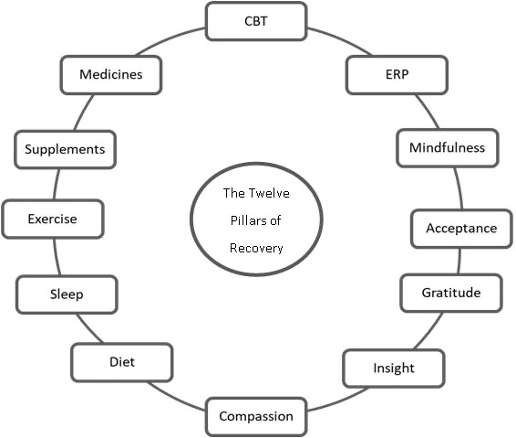
There are twelve pillars of recovery from OCD, as shown in Figure 2.4.1. Working with these twelve pillars will speed up your recovery process. The first two pillars to recovery are Cognitive Behavioral Therapy (CBT) and ERP. Although ERP is a specialized type of CBT, I have kept the two separate because CBT includes psychoeducation that helps modify behavior through ERP. Hence, these are the first two pillars. The next five pillars have the acronym MAGIC (mindfulness, acceptance, gratitude, insight, compassion). The next four pillars are diet, sleep, exercise, and supplements. The twelfth pillar is medicines. Out of these twelve pillars, this course book will mainly focus on the first seven pillars, i.e., CBT, ERP, mindfulness, acceptance, gratitude, insight, and compassion.
Figure 2.4.1: The Twelve Pillars Of Recovery
In the next section, let us look at these twelve pillars of recovery.
Ready to begin your recovery journey?
- Worksheets for ROCD
- Worksheets for Harm OCD
- Worksheets for POCD
- Worksheets for Religious OCD
- Worksheets for Incest OCD
- View the book series
- Write to me
Recent Comments