
Overcoming ROCD
- Do you constantly question whether your partner truly loves you?
- Do you find yourself wondering whether you really love your partner?
- Do you feel that something is wrong with your relationship, even when everything appears to be going well?
Doubt and uncertainty are a natural part of every romantic relationship. Most people occasionally have questions. About their feelings, their compatibility, or the future of their relationship. For people with ROCD, these doubts can become persistent and distressing.
In ROCD, intrusive thoughts and uncertainty become focused on romantic relationships. People with ROCD may find themselves repeatedly questioning
- Their feelings for their partner.
- Their partner’s feelings for them.
- The “rightness” of the relationship.
What begins as a simple question can quickly develop into an endless cycle of doubt, anxiety, reassurance-seeking, and mental analysis.
People with ROCD spend hours examining their feelings and comparing their relationships to others’. They may spend time searching for certainty, reviewing past interactions, or looking for signs that something is wrong. Although these behaviours may provide temporary relief, they strengthen the OCD cycle. As a result, doubts return with even greater intensity.
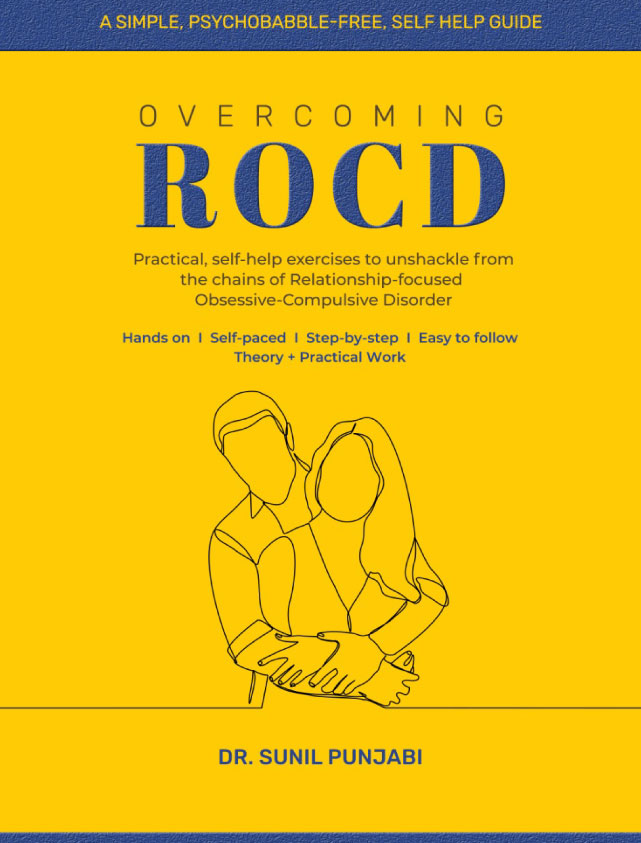
Overcoming ROCD is the culmination of years of work with clients struggling with it. This practical self-help guide provides readers with a structured approach to understanding and managing ROCD while developing healthier ways of responding to uncertainty.
The book explains how ROCD develops, why relationship doubts can become so persistent, and how compulsive attempts to find certainty often keep the problem alive. Readers learn how to identify their triggers, intrusive thoughts, compulsions, reassurance-seeking behaviours, and avoidance patterns so they can begin breaking free from the cycle.
How This Book Will Help
At the heart of the book is Exposure and Response Prevention (ERP), the most effective psychological treatment for OCD. Through practical examples and step-by-step exercises, readers learn how to face uncertainty about their relationships without becoming trapped in compulsive checking, analysing, or reassurance-seeking.
Drawing upon principles from mindfulness and acceptance-based approaches, the book also teaches readers how to relate differently to difficult thoughts and emotions. Rather than attempting to eliminate doubt completely, readers learn how to tolerate uncertainty, make room for discomfort, and focus on building meaningful relationships guided by their values rather than their fears.
The book includes practical exercises and worksheets designed to help readers apply recovery principles to their own experiences. These tools can be used to identify OCD patterns, track progress, challenge compulsions, and develop greater confidence in navigating relationship uncertainty.
If you are exhausted by constant doubt, trapped in endless analysis, or struggling to enjoy your relationship because of obsessive fears and uncertainty, this book offers practical tools and evidence-based strategies to help you move towards recovery.
What You’ll Learn
-
What Relationship OCD (ROCD) is and how it develops
-
The difference between normal relationship doubts and ROCD
-
Why certainty-seeking keeps relationship anxiety alive
-
Common compulsions associated with ROCD
-
How reassurance-seeking affects relationships
-
The principles behind Exposure and Response Prevention (ERP)
-
Mindfulness and acceptance-based approaches to managing uncertainty
-
How to respond differently to intrusive relationship doubts
-
Practical exercises and worksheets to support recovery
-
Ways to build healthier relationships without relying on certainty
Frequently Asked Questions
What is Relationship OCD (ROCD)?
Relationship OCD, or ROCD, is a subtype of Obsessive-Compulsive Disorder in which intrusive doubts and fears become focused on romantic relationships. Common concerns include whether one truly loves a partner, whether a partner truly loves them, whether the relationship is “right,” or whether a better relationship might exist elsewhere.
How is ROCD different from normal relationship doubts?
Most people experience occasional uncertainty in relationships. ROCD involves persistent, distressing doubts that lead to significant anxiety and repetitive behaviours aimed at finding certainty. The issue is often not the doubt itself, but the compulsive attempts to resolve it completely.
Does having doubts mean I am in the wrong relationship?
Not necessarily. Doubt is a normal human experience and can occur in both healthy and unhealthy relationships. ROCD often creates a sense of urgency that demands certainty about questions that may not have definitive answers. Learning to tolerate uncertainty is an important part of recovery.
What are common compulsions in ROCD?
Compulsions can include repeatedly checking feelings, analysing attraction levels, comparing relationships, seeking reassurance from friends or partners, reviewing past interactions, researching relationships online, or mentally debating whether the relationship is right. While these behaviours may temporarily reduce anxiety, they often strengthen OCD over time.
What is Exposure and Response Prevention (ERP)?
Exposure and Response Prevention, or ERP, is the most widely recommended psychological treatment for OCD. ERP involves gradually facing feared thoughts, situations, or uncertainties while resisting compulsive responses. Over time, this helps reduce fear and teaches the brain that uncertainty can be tolerated without relying on reassurance or mental rituals.
Can ROCD be overcome?
Many people with ROCD experience significant improvement through evidence-based treatment such as ERP. Recovery does not require eliminating doubt entirely. Instead, it involves changing the way doubt is responded to so that it no longer controls daily life or relationship decisions.
Whom is this book for?
This book is intended for individuals struggling with persistent relationship doubts, excessive reassurance-seeking, compulsive checking of feelings, fears about relationship compatibility, or uncertainty about romantic relationships. It may also be useful for partners seeking to better understand ROCD and mental health professionals looking for a patient-friendly resource.
Why does ROCD target relationships?
OCD often attaches itself to things that matter deeply to us. Relationships involve important values such as love, commitment, trust, and connection. Because these areas are meaningful, they can become fertile ground for OCD to generate doubt, uncertainty, and fear.
Is this book suitable alongside therapy?
Yes. Many readers find that self-help resources can complement professional treatment by reinforcing recovery principles between therapy sessions. The exercises and worksheets in this book are designed to support learning and practice, while professional guidance can help tailor treatment to individual needs.
Important Note
This book is intended as a self-help resource and educational guide. It is designed to complement professional treatment, not replace it. Readers experiencing significant distress are encouraged to work with a qualified mental health professional, particularly one with experience treating OCD using evidence-based approaches such as ERP.