
- Books in the series:
- Section 1 – Introduction to OCD
- Author: Dr. Sunil Punjabi
Quick summary
- OCD affects ~2.5–3% of people and is defined by a cycle of obsessions >> anxiety >> compulsions >> temporary relief >> repeat, which eventually causes dysfunction.
- Obsessions are intrusive, disturbing, and persistent thoughts (including images/urges) that trigger distressing emotions. These occur in everyone, but in OCD they become “sticky” and hard to dismiss.
- Compulsions are physical or mental actions performed to reduce this distress. They provide short-term relief but reinforce the cycle, making obsessions return more strongly.
- OCD becomes a disorder when this cycle repeats frequently and impairs daily functioning (work, relationships, etc.).
- It is a neurotic disorder, meaning sufferers recognize their thoughts/behaviors as irrational but cannot control them.
- A key challenge in recovery is distinguishing obsessions vs compulsions, especially because of mental compulsions.
Table of contents
- OCD and obsessions
- Compulsions
- The anxiety cycle diagram
- Neurotic disorders
- Distinguishing obsessions and compulsions
OCD and obsessions
OCD, or obsessive-compulsive disorder, is a severely debilitating mental disorder that affects 2.5-3% of the population (Robbins et al., 2019). Understanding the three words that make up ‘obsessive-compulsive disorder’ can give you a better understanding of the disorder. The first word is “obsessive,” which comes from “obsessions.” Obsessions could be in the form of thoughts, images, impulses, or urges (American Psychiatric Association, 2013), or even feelings, sensations, emotions, and dreams, but for simplicity’s sake, we shall club them together and refer to them as thoughts. Obsessions are thoughts that are intrusive, disturbing, and sticky.
Intrusive, because they pop out of nowhere when you least expect them. Disturbing, because the content is never pleasant. It is always about something bad that may happen, often extreme. Sticky, because the more you try to get rid of them, the more they seem to refuse to leave. For example, getting a thought that your partner may be cheating on you is an obsession in Relationship OCD. Or, getting a thought that you may not have locked your house door is an obsession in Checking OCD. Or, in the case of Incest OCD, getting an impulse to become sexual with a parent/sibling/child is an obsession.
These thoughts may cause unpleasant feelings such as extreme anxiety, guilt, sadness, restlessness, disgust, self-loathing, or self-criticism, which are again intrusive. Remember that these are just your emotions, and these emotions are intrusive too. They accompany your intrusive thoughts, and no matter what you do to make them go away, they don’t. For example, you get the thought that you want to see your sibling naked. Or you may get thoughts of hurting someone. These are intrusive thoughts. Your mind tells you if you were a good person, you would not get such thoughts. These thoughts don’t go away when you try to make them go away, causing guilt. In this case, guilt is intrusive too.
Compulsions
Through trial and error, you may have identified some actions that initially help relieve the intrusive emotions caused by these thoughts and even make the thoughts come unstuck. These actions, which may be physical or mental, are compulsions. The second word, “compulsive,” comes from “compulsions.” Compulsions are physical or mental actions you may end up doing to neutralize your obsessions (American Psychiatric Association, 2013). For example, constant monitoring of your partner’s whereabouts, social media, and mobile phone activity (to catch her in the act of cheating) is a compulsion in Relationship OCD. Going back to check if you have locked the house door and checking it multiple times is a compulsion in Checking OCD. Avoiding hugging your parent/sibling/child is a compulsion in Incest OCD.
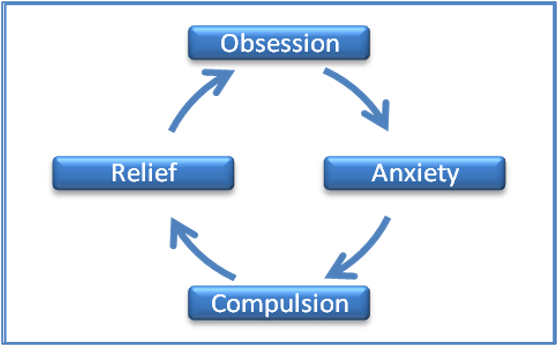
Interestingly, everyone (even someone without OCD) has intrusive thoughts. Julien et al. (2009) conducted a study with two groups—students and OCD patients—and found that both groups had intrusive thoughts. Abramowitz et al. (2014) quoted studies in their paper stating that up to 90% of people experience intrusive thoughts similar to obsessions in OCD. For example, when you leave a restaurant, you may suddenly get an intrusive thought of having left your wallet or mobile phone back in the restaurant. It may cause you to quickly check if you do have the wallet or mobile phone on you. When you find that you do have it, you may forget about it. But for a sufferer, the thought may get obsessive, and they may have to do the same compulsion repeatedly to deal with the obsession. The compulsion may provide temporary relief, and then the obsession may return. This may lead to a repetitive cycle of obsession > anxiety > compulsion > relief, as shown in Figure 1.2.1.
Eventually this cycle may repeat many times over and may begin to cause dysfunctionality. This dysfunctionality may extend to work, family, relationships, studies, or anything else that is important to them. That is when it becomes a disorder, which is the third word—disorder.
The anxiety cycle diagram
Figure 1.2.1: The Anxiety Cycle
Neurotic disorders
OCD belongs to a class of mental disorders called neurotic disorders. Neurotic disorders are those where the sufferer understands the irrationality of their thoughts but is not able to modify their behavior. Disorders like anxiety, depression, OCD, and PTSD are all neurotic disorders. The sufferer knows their actions are unhealthy and unhelpful but cannot stop themselves from doing them.
Thus, an OCD sufferer may know that their thoughts about incest are irrational because they do not really want to do that. But the thoughts are so strong that they may not be able to dismiss them. Furthermore, they also know that they should not be avoiding interaction with family members, but they cannot face them without becoming anxious.
Distinguishing obsessions and compulsions
People are often confused about what an obsession is and what a compulsion is. The confusion is caused by the presence of many mental compulsions. This may often lead to treating one like the other. In a disorder that is anyway confusing even if everything is laid out on a platter, such confusion about the building blocks themselves can make the recovery process more difficult. I have therefore created an exercise to help you understand the difference.
Worksheet 1.2 has been provided for you to test yourself on whether or not you can distinguish between obsessions and compulsions. Before moving to the next chapter, complete Worksheet 1.2 to get a better understanding of the difference. Move to the next chapter only if you have a better understanding of the difference between obsessions and compulsions.
Compulsions provide temporary relief, but they keep the obsession alive.
Ready to begin your recovery?
- Worksheets for ROCD
- Worksheets for Harm OCD
- Worksheets for POCD
- Worksheets for Religious OCD
- Worksheets for Incest OCD
- View the book series
- Write to me
Recent Comments